

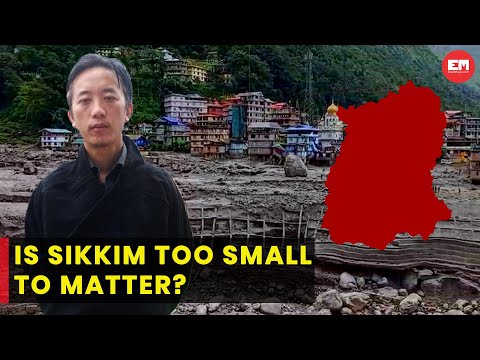
The debris has settled, the death certificates for missing persons are being made, and Chungthang, the once-picturesque town that turned into a ghost town in the early weeks of October, is limping to normalcy, whatever qualifies for normalcy in a town whose entire existence was shaken.
And in a country where we wake up everyday to browse for reasons to be outraged, the story of how India’s most prosperous state was left reeling has already been forgotten. Not that it received due attention when it needed it the most.
But what must not be forgotten is that while the Sikkim disaster occurred in October, it took decades of ‘planning and hard work’ to bring the state to its knees. Planning, to ensure that several violations are either ignored or buried deep, and hard work so that those who were making money continued to do so for years.

Take the Sikkim government, for example. In its internal correspondence, the Sikkim government admitted that the letter of intent (LOI) it had issued to Athena Projects Private Limited for the construction of the Teesta Stage III 1200 MW project, was the State’s hydropower policy.
Before the deluge: Red flags for over a decade
The memorandum of understanding (MOU) or memorandum of agreement (MoA) signed with the special purpose vehicle (SPV) Teesta Urja Limited (TUL) and the Sikkim government, was deemed as the standard agreement for other independent power producers (IPPs) with more or less same set of terms, subject to minor alterations for MOU or MoA. This was concurred by the high-powered hydro committee and endorsed by the cabinet.
The specific clause in the MOU which deals with equity subscription (4.9.1) says, “The company shall not change the constitution of the company’s board without prior permission from the government.” If there is a violation of this clause, the Government of Sikkim (GoS) can unilaterally terminate the agreement.
Another vital point violated from the equity subscription clause was that the IPPs were to arrange the funds for the Sikkim government share of equity of either 26% or 11%, and the amount thus arranged was to be adjusted against the revenue stream of the state’s share of 12% free power as per the MOU.

In the most startling and brazen violation of this very clause, the Sikkim government had to move to court to get a restraining order against TUL for the dilution of shares to third parties without its consent, while at the same time denying the Sikkim government its share of 26% equity.
TUL finally offered the Sikkim government its share of 26% equity for which it had to borrow Rs 296 crore in July 2012 after the Sikkim government moved to the court.

TUL did not arrange the funds for the equity.
During this time, a huge amount was also pumped into private companies or independent power producers (IPPs) developing hydropower projects in Sikkim after the Central Government allowed 100 per cent FDI in the power sector through the direct route.
An in-depth analysis of these investments shows that the finances were pumped in from tax havens like Singapore and Mauritius by companies registered in these countries by Private Equity (PE) funds, venture capitalists and hedge funds.
The best case study in this connection is TeestaUrja Limited (TUL), now Sikkim Urja Limited, an SPV (Special Purpose Vehicle) set up by Athena Projects Pvt Ltd for developing the 1200 MW Teesta Stage III hydropower project near Chungthang in North Sikkim.
The Singapore-based Asian GencoPvt Ltd owned by TV Vijaykumar, an erstwhile close aide of the late YSR Reddy (former Chief Minister of Andhra Pradesh), the late CV Balayogi (former Speaker, LokSabha, also from Andhra), Jagan Mohan Reddy (YSR’s son, now CM of Andhra) and KVP Ramachandra Rao (close associate of the Reddys). Until recently, it held close to 50 per cent equity in the project.
A clique of investors, led by Morgan Stanley Infrastructure Partners, bought close to 49 per cent stake in power generation and engineering services firm Asian Genco for $425 million in 2010, the biggest private equity (PE) transaction in India in the power sector.
The group of private equity (PE) investors in Asian Genco included US-based Morgan Stanley Infrastructure Partners, Everstone Capital, General Atlantic, Goldman Sachs Investment Management and Norwest Venture Partners, among others.
Asian Genco, (which has the former power secretary of Delhi RV Shahi as a consultant) had earlier raised funds from other investors like power trading firm PTC and its finance offshoot, PTC Financial Services, besides global investors such as Tiger Global Management.
This has been a trend for many of the Independent Power Producers (IPPs) developing projects in Sikkim, (as per the MoU, the government of Sikkim owns either 26 per cent or 11 per cent equities in some of these projects).
In 2008, TUL took Rs 4,500 crore as a loan from a rural electrification corporation (REC) and a consortium of seven nationalised banks and parked the funds in Asian Genco.

Teesta Lanco hydropower projects who were awarded Teesta VI hydropower projects did the same with investments in coal mines in South Africa, Griffin mines in Australia and a coal mine and a thermal power plant in Chhattisgarh, all with the help of finances from land mortgaged in Sikkim.
After liquidation, Teesta Lanco was acquired by NHPC.
Coastal Projects Sikkim sold shares at a premium to Baring Asia Equity Group at 65 times the face value; such value addition is fully and only attributable to their ownership of the concerned hydropower project they are executing in Sikkim. Jal Power Corporation Limited was tasked with executing the 120 MW Rangit IV hydropower project. After reaching insolvency, the project is now taken over by NHPC.
Jal Power Corporation Limited is a wholly-owned subsidiary of Coastal Projects Private Limited, Hyderabad. In the 75:25 debt-equity ratios of Coastal Projects in the JV, the Sikkim government has, at the rate of 26 per cent equity, Rs 50.40 crore.
Had Jal Power executed the required Shareholder Agreement (Share Subscription Agreement) and allotted the Sikkim government 26 per cent equity within 180 days of the agreement, the state government, as a minority shareholder, would have got first preference to dilute and could have decided to off-load parts of its equity at 65 times the face value.
In this way, the state government was denied its dues and gains which the private developers tactfully and wrongfully embezzled (Source: Coastal Annual Report).
Private developers, who got projects through joint venture (JV) routes, enriched themselves at the cost of the state and its people.
Likewise, the Luxembourg-based Greenko Energy Ventures Private Limited controls the shares in the 96MW Dikchu Hydropower Project, a JV between the Sikkim government and Sneha Kinetic Power Projects Private Limited (an SPV). The Sikkim government is entitled to 26 per cent equity in it. Greenko has raised $46.3 million in allotting its preference shares (Source: Greenko Annual Report).
In the remand report of Jagan Reddy, the Central Bureau of Investigation (CBI) has clearly stated that in his Sandur Power Company Limited (SPCL), the Lanco group has purchased considerable shares. Lanco was doing the Teesta Stage VI project in Sikkim, which after reaching NCLT, was acquired by NHPC.
The Singapore-based River Valley Hydro Venture owns a 75 per cent stake in Secunderabad-based AmritJal Ventures, worth Rs 300 crore. AmritJal has floated three SPVs, Gati Infrastructure, Gati Infrastructure Bhasmey and Gati Infrastructure SadaMangder for three projects in Sikkim. According to an Economic Times report (February 19, 2009), the owners of Amri Jal Ventures were not clearly known.
Mauritius-based Varuna Investments Private Limited holds 100 per cent preference shares of Singapore-based Asian Genco, owned by TV Vijay Kumar. Asian Genco owns 50.9 per cent equity of TUL, leaving 49.1 per cent equity for the consortium partners of Athena Power Projects Limited (APPL) and the Sikkim government which is supposed to hold 26 per cent equity in the JV.
The dubious silence of the former CM
In reality, the GoS under Chief Minister Pawan Chamling chose not to disturb the status quo, despite gross illegality, MoU violation and quid pro quo benefits enjoyed by the troika of politicians, bureaucrats and businessmen, not to mention huge losses to the state exchequer.
In reply to an RTI application, the private hydropower developers said that, as a private limited company, they are outside the purview of the RTI Act, 2005, and it is not applicable to them; signatories to the MoU have no rights under the implementation agreement with the company.

In many cases, the original owners are untraceable or have become minority shareholders, having sold or transferred their equity to third parties who have nothing to do with the MoU or the GoS. Indeed, this raises serious legal issues.
Teesta Urja Ltd formed its own construction company, Abir Infrastructure Pvt Ltd, for project-related works. That company belongs to Teesta Urja Ltd with the same shareholders and even shares the same address.
As per the Government of India guidelines for JV projects or projects through the MOU route, the engineering procurement contract or EPC has to be awarded through competitive bidding. In stark violation, Abir was awarded the EPC contract by MOU in 2007.
Irregularities noticed, never acted upon
The CAG reports of 2009 and the report of 2015-16 explain in detail the illegalities and arbitrary allotment of hydropower projects in Sikkim.
The Sikkim government had, in June 2004, set a target of producing 3,000 MW of additional power by the end of 2012.
A cascade of projects on the Teesta–including Teesta Stage I 320 MW, Stage II 480 MW, Stage III 1,200 MW, Stage IV 520 MW, Stage V 510 MW and Stage VI 500 MW–were conceived and sanctioned, with the approval of the CWC and the Central Electricity Authority (CEA).
The state government set up a high-power committee in June 2004 to expedite the development of hydropower projects, the CAG noted in the 2016 report. Four proposals for Teesta III–from Cosmos Electric Power Supply Limited (CEPSL), NHPC, Reliance, and Sutlej Jal Nigam Vidyut Limited (SJVNL)–were received, and the HPC had recommended the proposal of the consortium led by CEPSL proposal twice that year. The cabinet first did not accede to the recommendation in October 2004, and on the second occasion in November 2004, deferred “for reasons not on record”, the CAG noted.
Norwegian state-owned power company Statkraft AS and global private equity (PE) fund Actis Llp are separately looking to acquire the Indian hydroelectric assets of Singapore’s Equis Pte. Ltd, valued at around ₹2,700 crore.
Equis-owned Hydreq owns and operates two hydroelectric plants in Sikkim, the Jorethang Loop 96 MW and the Tashiding 97 MW, both of which were awarded by MoU route to the DANS energy group. In both these projects, the Sikkim government did not have any equity but was entitled to 12% free power.
The sale of Hydreq was proposed after a group of investors led by Global Infrastructure Partners announced plans to acquire Equis Energy for $5 billion in October 2017. Equis Energy was focused on solar and wind power projects.
Equis Pte. Ltd (Equis) and Global Infrastructure Partners (GIP) announced today the execution of binding documentation for the sale of 100% of Equis Energy for USD5.0 billion (including assumed liabilities of USD1.3bn) in cash to GIP and co‐investors. The transaction is subject to customary regulatory approvals and is expected to close in the first quarter of 2018.
Japan’s financial services firm ORIX Corp. and Greenko Energy Holdings have concluded a deal for the investment of $980 million in Greenko. This is the single largest foreign investment transaction in India’s clean energy space. In addition, Greenko has also completed the acquisition of a 40% stake in Teesta Urja Ltd, which is setting up the 1.2 gigawatt (GW) hydropower project in North Sikkim, for $250 million.
Private preference over government agencies?
A very interesting trend seen in Sikkim, again pointing to corruption, is that many projects were awarded to independent power producers (IPPs), either in JV with the Sikkim government, or independently with no government stake, whereas state-owned NHPCs were rejected by the then Sikkim government.
Dear Reader,
Every day, our team at EastMojo travels through rain, rough roads, and remote hills to bring you stories that matter – stories from your town, your people, your Northeast.
We do this because we believe in truthful, independent journalism. No big corporate backing, no government pressure – just honest reporting by local journalists who live and breathe the same air you do.
But to keep doing this work, we need you. Your small contribution helps us pay our reporters fairly, reach places others ignore, and keep asking the tough questions.
If you believe the Northeast deserves its own fearless voice, stand with us.
Support independent journalism. Be a Member.
Thank you,
Karma Paljor
Editor-in-Chief, eastmojo.com


Teesta Stage III itself was given to NHPC way back in 1987 as records show. The Teesta Stage IV in Dzongu, Teesta Stage V, the Teesta Stage VI and Jal power corporation Rangit IV 120 MW, are all being taken over and run by the NHPC.
This is in addition to Rangit II which NHPC was already successfully running. Interestingly, in Dzongu the 300 MW Panan hydropower project awarded to Himagiri Hydropower Projects Private Limited, also evinced interest from NHPC due to the developer facing time and cost overruns, and financial constraints. Sikkim government has 26% equity in Panan.
These projects if given to NHPC might have by now started contributing revenue to the state and power to the national grid, but the greed and corruption in the awarding of projects led to losses in cost and time overruns, ultimately, NHPC was called to salvage the projects, while the politicians, bureaucrats and businessmen enriched themselves at the expense of the public exchequer.
And all this added up to turn into the disaster we witnessed on October 4.
Also Read | Roar from the Himalayas: Tiger spotted in Sikkim at 3,640 metres