

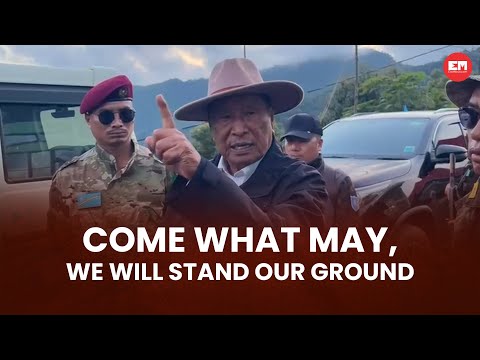
In 2010, Thuingaleng Muivah, general secretary of the Nationalist Socialist Council of Nagalim (Isak-Muivah) faction, the most powerful insurgent group in the North East, tried to visit his native village in the Ukhrul district of Manipur.
However, the Manipur government stopped him, citing security concerns. It was an excuse intended to prevent Muivah from galvanising his supporters for the long-cherished dream of Nagalim – a Greater Nagaland envisioned to unite all Naga-inhabited areas across parts of northeastern India and northwestern Myanmar into a single political entity.
The proposed territory included parts of present-day Manipur, which the Meitei consider to be part of their ancient kingdom, Kangleipak.

But this time around, Meitei and Kuki-Zomi civil society bodies were also present to welcome him back. And thus, after over 50 years, Thuingaleng Muivah finally returned home.
The visit of Muivah comes at a very critical moment in Manipur’s history. For the last two years, the Meiteis and Kuki-Zomis have been fighting a civil war, which has resulted in over 250 deaths and the displacement of over 60,000 people.
The conflict took most people by surprise, as they had expected something similar to erupt between the Meiteis and the Nagas, given the demand for Nagalim.
In 2001, a massive protest broke out in the Meitei-dominated valley against the extension of the 1997 Indo-Naga ceasefire between the Government of India and the NSCN-IM to Naga-inhabited areas of Manipur.
However, those who know Manipur society are well aware of the resentment among the hill communities, including the Kuki-Zomi, at the monopolisation of political power by the Meitei, which has led to their marginalisation.
The 2021 North-Eastern Region District SDG Index Report & Dashboard for 2021-22 clearly revealed the disparities existing between the Meitei-dominated districts in the valley and the tribal-dominated districts in the hills.
The rapidity with which the conflict became a civil war surprised me a bit, but considering the proliferation of violence in the state, it was not completely unexpected.
When the violence was going on, the Manipur government made every attempt not to antagonize the Nagas lest they join the conflict. Therefore, when someone assaulted Nagas, suspecting they were Kuki-Zomi, the government quickly apprehended the culprits.
So, the Meitei civil society’s presence might have aimed at appeasing the Nagas to stop them from rebelling, mainly because the Kuki-Zomi had already rejected Manipur’s territorial integrity.
The Kuki-Zomi, on the other hand, would like to have Naga support for their demand for separate administration. However, the Nagas have grievances against the Meitei and the Kuki-Zomi. Nagalim will require the Meitei to compromise on the territorial integrity of Manipur, which they will vehemently oppose.
Nagas also claim that a lot of the areas where the Kuki-Zomi currently live belonged to them, which have now become overrun with illegal immigrants from Myanmar.

Therefore, quite a few Nagas that I have discussed with favour an NRC-type exercise to identify the suspected illegal immigrants who have entered from across the border. However, the data reveal a completely different reality.
There has indeed been a rise in the Kuki-Zomi population in the state of Manipur. However, the increase was only by 1% during the period from 1951 to 2011.
Could factors other than migration have caused the rise in population? Also, even if there’s migration, has it reached a scale that threatens the demographic equilibrium of the state?
Such a claim does not seem to be strongly supported by the data. Of course, when someone is strongly convinced of their own position, data will not change their mind.
The Nagas and the Kuki-Zomi have already fought each other in the past. The latest one was during the 1992–1997 Naga-Kuki conflict, which killed hundreds of people. With the Kuki-Zomi demanding a separate administration for Kuki-Zomi-inhabited areas, a future clash with the Nagas over the proposed Nagalim is a possibility.
If one looks at the map of the proposed Nagalim, one can find that it also includes areas outside Manipur and Nagaland.

In Arunachal Pradesh, these are areas that are inhabited by the Konyaks, Nocte, and the Wanchos, while in Assam, these include areas that are under present-day Karbi Anglong. But there are a couple of problems with such claims.
The Konyaks, Nocte, and Wanchos, though they politically identify themselves as the Nagas, are not ethnically Nagas. Instead, they belong to a language group that includes the Kok-Borok (languages spoken by Bodo, Garo, Dimasa, Tripuri) and the Jingpho-Luish, spoken by the Singpho in Arunachal Pradesh, also known as Kachin in Myanmar.
The Nagas (non-Konyak groups), Meitei, and the Kuki-Zomi belong to the Kuki-Chin-Naga language group, so not very long ago these three groups had a common ancestor from whom they all diverged. The Konyaks are more closely related to the Bodos, Garos, and Tripuris instead.
Since identity politics plays a significant role in the North East, how long will it be before the Konyaks come to realise that their ancestry and affiliations may actually lie elsewhere? The NSCN-Khaplang faction is already a major competitor of the NSCN-IM.
The claim to parts of Karbi Anglong is because of the settlement of the Rengma Nagas in certain parts of the district.
However, it is ironic that the Nagas claim to incorporate those parts into the proposed Nagalim, considering that Charles Lyall clearly mentioned in his 1908 book The Mikir that the Rengma Nagas were recent immigrants into what is today Karbi Anglong. They came from the eastern side of the Dhansiri River, from what is today Nagaland.
Because the book was written in the early 20th century, the migration must have taken place within the previous hundred years.
Therefore, if the Kuki-Zomis are recent migrants and their territory rightfully belongs to the Nagas, what justifies claiming parts of Karbi Anglong when the Nagas are the recent migrants in this area?
So, claims and counterclaims also have their own issues, and vested parties have always played fast and loose with genuine history on the ground.
Dimapur is another good example. A very important town, in fact, the commercial capital of Nagaland, the name itself reveals it is historically a non-Naga area. During the 13th century, it was in fact the capital of the Dimasa Kingdom until it was captured by the Ahom ruler Suhungmung in 1526 A.D.
Known also as the Kacharis, they were one of the chief rivals of Hima Jaintiapur. So, the Nagas’ coming into this area is quite recent. But today it is an integral part of Nagaland, proving that historical antecedents may not always translate to political dominance in the present.
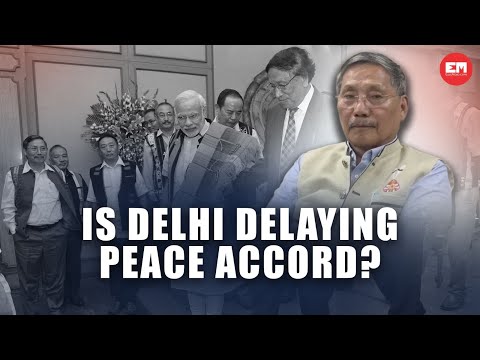
The arrival of Muivah in his native village is meant to keep the pressure on the Indian state, especially on the issue of the Naga flag and a separate Constitution. In his statement, he has already indicated the same.
But even if the Indian state accedes to those demands, the proposed territory of Nagalim will pose a big hurdle.
Would the Karbis and Dimasa allow implementation in areas where Nagas are recent migrants? Will the Kuki-Zomi accept the land they consider their own to come under such an agreement? Will Arunachal Pradesh allow Nagalim to be extended to territories of communities that are not ethnically Nagas? Will the Meiteis allow Nagalim to be created in the territory they claim to be part of their history?
So, the road forward for the Nagas to realise the outcome of the decades-long struggle is still quite difficult. So, Muivah’s visit, though highly crucial, might still not be enough to fulfill the long-cherished dreams of the Nagas, for which many have fought and died. And that is a travesty not just for the Nagas but for the entire region because it means peace is still far away.
Views expressed in the article are those of the author and do not reflect in any way his affiliation to any organisation or institution

You just read a story that took days to report. Help us keep our reporters on the ground in the Northeast.
Ad-free reading, support and keep important stories alive
Support once (any amount)

Scan to pay via UPI