

National Award-winning filmmaker Kripal Kalita’s latest documentary film Hati Bondhu (Friends of Elephants) brought laurels to Assam by emerging as the state’s only selection in the Indian Panorama section of the 53rd International Film Festival of India (IFFI) scheduled to be held from November 20 to November 28 at Goa, India.
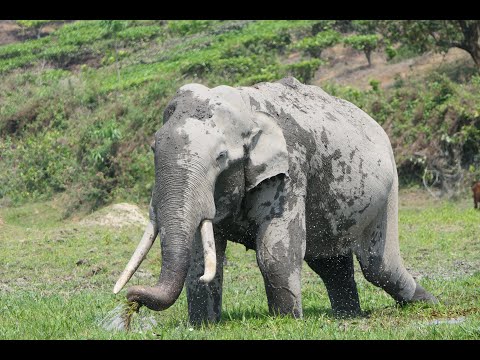
Hati Bondhu focuses on the issue of man-elephant conflict in Assam. This conflict has increased dramatically in recent times as a result of the destruction of forests areas and vegetation cover, developmental activities, disturbances in the elephant corridors, and the expansion of the human population, which has severely contributed to the loss of wildlife habitat. These conflicts result in the tragic death of both men and elephants.

“Of course, the Indian Panorama selection is great news for us. We are attempting to emphasise the solution for a peaceful co-existence between human beings and wildlife. And now that the film has been selected for what is perhaps India’s largest international film festival, the message will reach a wider audience,” said director Kripal Kalita.
The documentary also highlights the efforts of the non-profit organisation Hati Bondhu in the Ronghag- Hatikhuli area of Nagaon District, Assam, which functions under the leadership of its octogenarian founder-president, Pradip Kumar Bhuyan.
Elephant herds would frequently descend the reserve forest areas and enter the village, causing massive destruction to life and property. The NGO promotes community preservation, and is working tirelessly to mitigate these conflicts between man and elephants by providing a sustainable solution to the problem while promoting mutual co-existence.
“We are grateful to director Kripal Kalita that he has attempted to place our efforts in front of the public. And people have also liked it. This is a good thing because not only us but our place is also being recognised in the process. It will definitely help trigger a change of mindset among the people and will undoubtedly cause a shift in their attitudes towards nature and wild animals,” said Binod Dulu Bora, an award-winning nature conservationist and wildlife enthusiast committed as a director of habitat restoration programs with NGO Hati Bondhu.

Also Read | Assam: Wild elephant wreaks havoc in Tezpur
On asked what Hati Bondhu does, Bora replied, “I am primarily a wildlife rescuer. When I met Pradip Kumar Bhuyan Sir, we tried to discuss a long-term solution to the ever-growing problem of man-elephant conflict, in which both sides lose lives.”
“So, after mapping the entire area with traditional methods, we figured out when the elephants came out of the jungle, where they meet, and eat before separating into different directions, their daily routes, their eating patterns, and everything. So, after understanding their psychology, we identified three spots and started cultivating paddy for them to eat first in order to save the village and the rest of the cultivations,” he added.
Most human-elephant conflicts in Assam occur between November and January during harvest. Attracted by the smell of ripe paddy, elephants are forced to forage on community crops to meet their nutritional needs which have depleted due to habitat loss. Because Assam is primarily an agrarian state, such activities have a negative impact on the livelihood of farmers and tend to foster negative attitudes toward wild elephants in the local community.
“We have tried very much to focus on the grave issue of the man-elephant conflict in Assam. The first eighteen minutes of the film, out of its fifty-three minutes runtime, is purely an exploration of the multi-dimensional issue, its causes and its impacts. After that, the focus shifts to the NGO Hati Bondhu and their positive role in community preservation and mitigation of the conflict,” said Kalita, whose Bridge had won the National Award for Best Feature Film in Assamese in the 68th National Film Awards.

Also Read | Assam elephant ‘mistreated again’ in Tamil Nadu temple: PETA
The NGO, with the aid and assistance of Assam’s forest and agriculture departments and the locals, have come up with – The Jumbo Khet (Elephant Farm), a one-of-a-kind initiative to cultivate paddy, Banana, Napier grass and Broom grass in 200 bighas of land for elephants to eat in order to keep them away from wandering into farmers’ fields and causing destructions.
Now in its fourth year, the successful efforts of Binod Dulu Bora, Meghna Mayur Hazarika, Roon Bhuyan, Shibanjali Mahanta and Leona Bhuyan led by environmentalist Pradip Kumar Bhuyan along with cooperation from the villagers of Ronghag-Hatikhuli have reduced elephant raids in the fields and have brought down man-elephant conflicts to almost zero.
The issues of human beings, society, community and nature have always been at the centre of productions led by Kripal Kalita. He has previously directed twelve short films, and fifteen television serials amongst other video productions and has directed more than sixty stage plays.
“Yes, that’s true. Red to Black is about terrorism, Megh – The Cloud is about flood and hope of the people, Jaapi – The Roof of Assam is about our indigenous communities,” said Kalita recalling the subjects and themes of his past works.
His feature film Bridge showcases the plight of a poverty-stricken family in a river bank village in Assam yet to get a concrete bridge connecting it to the other side of the river. Disturbed by the perennial monsoon flood of the state, the film also comments on the social evils and other impediments that block the road to development in the village.
“Every artist, in my opinion, has a social responsibility. Joining the army is not the only way to show your love for your country. Therefore, I’ve used my medium of expression which is cinema and my voice is reflected in my works and that is my dedication and commitment to Assam,” he added.
The documentary Hati Bondhu (Friends of Elephants) is one of the 20 non-feature films to have made it to the selection list of the festival out of 242 non-feature films in competition. The film took nearly three years to complete, with assistance and input provided by all the members of the NGO.
“It was a very difficult venture for us. Nothing is predictable in a film about elephants. We sometimes had to turn on the camera and wait in the jungle for the elephants to arrive to capture a shot. The very fact that the elephants dictated our shooting schedule, this documentary took three years to complete,” said Kalita describing the difficulties faced while making the documentary film.

Also Read | Assam: Conservation body anguished over recent death of elephants
“We had to go out and shoot without any predetermined narrative since we didn’t know what shots we’ll get and what we won’t. It is because elephants are unpredictable. So, the narrative was set only when the shots were sewn together at the editing table,” he added.
Difficulties are also faced by NGO Hati Bondhu from time to time. In the words of Binod Dulu Borah, “The locals were initially very hostile to acknowledge our attempt of planting for the elephants. They had refused to lend their land to us thinking we will misuse it. It also resulted in numerous unfavourable situations for us. However, our continuous efforts and request to try it at least once didn’t go unanswered. And very soon these misunderstandings cleared up after we successfully saved the crops and avoided man-elephant conflict in the region. Then they willingly came forward to help us. Now instead of fighting off wild elephants, the locals have begun to cultivate paddy, first for the jumbos and then for themselves.”
“In the present times we haven’t got much attention from the government, but that’s okay because they’re busy, and we can’t put off our work in the hope of getting something. We’ll keep doing what we’re doing,” Borah, who is also credited as a cinematographer in the documentary film, added.
Borah also goes on to add, “Another issue is that many people accuse us of feeding rice grains or paddy to the elephants. However, we are trying to do the opposite. We are only feeding them crops worth 10 bighas of land to limit their consumption and then re-direct them to eat grass. Without any checks, earlier the elephants used to eat thousands of bighas of the land worth of crops. Destruction of farmers is a separate case. Furthermore, we have also constructed artificial water reservoirs near the fields for the elephants to drink from.”
He believes that if these steps are taken in other places as well, we will be able to completely eradicate man-elephant conflicts in Assam. He is also pleased with the interest shown in these activities by young research scholars and students who have visited these sites for educational purposes while re-affirming his faith in the documentary in inspiring a change.
When asked about the release plan of the documentary, director Kalita told EastMojo, “We usually don’t release documentary films in theatres here. Because they are considered to be boring films that practice a lot of point-to-point fact-providing service. But Hati Bondhu, as a documentary, is quite different. Rather than simply being factual, we have attempted to balance some elements of storytelling that would keep the readers invested and interested”.

“We have already organised a premier show of the documentary earlier this year in February. The audiences have loved the film and keeping these reactions in mind, we are also planning to give the film a limited release in the theatres of the state in January of next year,” he added.
With sound design and mixing by the National Award-winning sound designer Amrit Pritam, Kripal Kalita has also edited and worked on the music of the documentary film. Veteran actor Kulada Kumar Bhattacharya provided the English voice-over in the film, while the Assamese narration is provided by Nayan Prasad.
Also earning an official selection at the Indian Panorama section of the 53rd International Film Festival of India (IFFI) is Saikhom Ratan’s Beyond Blast from Manipur which is based on the tragedy of bomb blast victim – Konthoujam Maikel Meitei.
It is also noteworthy to mention here that Kripal Kalita’s documentary, Hati Bondhu, has already received several recognitions in several prestigious film festivals before its Indian Panorama selection. Some of the previous recognitions for the film include selections in the 17th Mumbai International Film Festival (MIFF) and Indian Documentary Film Festival of Bhubaneswar (IDFFB) 2022.

Also Read | Assam: Elephant dies in Nagaon after touching electrical wire

You just read a story that took days to report. Help us keep our reporters on the ground in the Northeast.
Ad-free reading, support and keep important stories alive
Support once (any amount)

Scan to pay via UPI