

Guwahati: A remarkable story of empathy and courage unfolded—not once, but twice in the forests and tea estates of Assam. Two wild Asian elephants, one tuskless and the other tusked, risked their safety to rescue sedated herd members, defying the norms of animal instinct. This extraordinary behaviour, captured during GPS-radio collaring missions, offers compelling evidence that elephants possess a social intelligence more profound than previously understood.
The observation has now been documented in Biotropica journal which describes how two adult male elephants, identified as MAK and TUS, exhibited behaviour that fits the scientific criteria for “rescue behaviour.” This term refers to situations where an animal places itself at risk to assist another, with no immediate benefit. The findings suggest that Asian elephants, like their African counterparts, possess the cognitive sophistication to recognize and respond to the distress of conspecifics. The team was from the Assam Forest Department, WWF-India and other institutions.
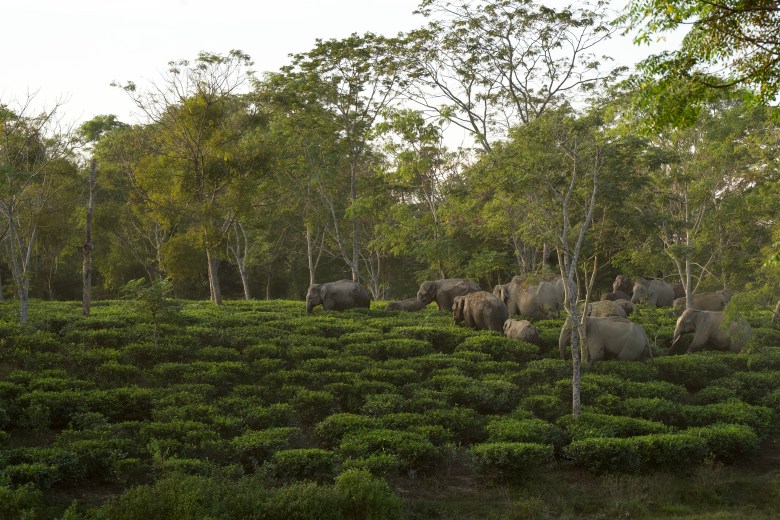
Incident 1: The Makhna’s Mission
The first act of bravery occurred in April 2021 at the Sonai Rupai Wildlife Sanctuary. During a routine GPS-collaring operation, a team of veterinarians and forest staff sedated an adult female elephant (FEM1). As the tranquillizer took effect, the herd scattered into the forest—all except one.
Emerging from the undergrowth like a guardian on a mission, a large tuskless male elephant, later identified as MAK, approached the groggy female. While the other elephants fled from the human presence, MAK defied instinct, moving closer to the sedated elephant. With slow, deliberate motions, he nudged her with his trunk and pressed his head against her side. Over the next several minutes, he persistently pushed her deeper into the forest, away from the human team’s watchful eyes.
The dense vegetation limited the team’s visibility, and attempts to follow were thwarted by the slow pace of their tracking elephants. After two hours of searching, the team concluded that MAK had successfully guided the female to safety. According to researchers, this act met all four criteria for “rescue behaviour” in animals: the female was vulnerable, the male approached at personal risk, his actions reduced potential harm, and he had no apparent immediate benefit for doing so.
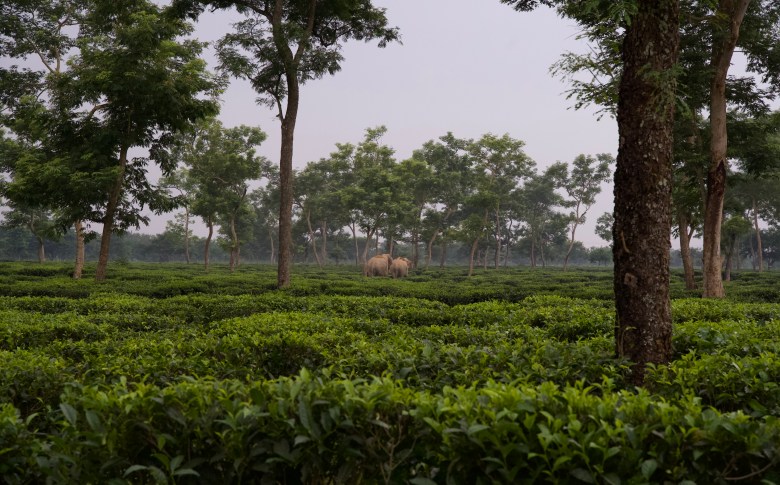
Incident 2: The Tusked Guardian of Addabarie
An even more dramatic event played out in November 2021 at the Addabarie Tea Estate. This time, a tusked male elephant, named TUS, intervened as researchers attempted to collar another adult female (FEM2). After being darted, FEM2’s body began to show the telltale signs of sedation—stillness, sluggish movements, and snoring-like sounds.
TUS, who had been foraging 400 meters away, noticed the shift in the herd’s energy. He strode toward the sedated female with purpose. Spotting the approaching human team, he positioned himself between them and the vulnerable elephant, creating a formidable barrier. The researchers watched as TUS used his tusks and head to nudge the female’s body, making sweeping, upward motions to reorient her toward the direction of the retreating herd.
For the next 10 minutes, TUS repeatedly nudged and pushed her until she regained enough coordination to move. Slowly but steadily, he guided her into the dense forest—the same thicket where the rest of the herd had gathered. Attempts to track them further proved futile. The scene bore an uncanny resemblance to MAK’s actions, but this time with an added element of strategic protection.
More Than Instinct: Decoding Rescue Behaviour
While elephants are known to push and prod each other during courtship or playful interactions, the team ruled out mating motives in both incidents. Neither of the sedated females displayed signs of estrus, and the absence of courtship behaviours such as mounting further dismissed the idea that the males were driven by reproductive instinct.
The study’s lead author, Arjun Kamdar, explained that these actions mirrored “body-guarding” behaviours seen in African elephants. “The deliberate approach of these males toward sedated females, coupled with their focused effort to move them away from a perceived threat physically, points to a form of empathy and goal-oriented action,” Kamdar said.
Body-guarding in elephants is not unprecedented. African elephants have been observed removing spears, tranquilliser darts, and even plastic bags from the bodies of their companions. In 2019, a study from Mudumalai National Park, India, documented an adult female protecting an emaciated calf from approaching humans. These actions demonstrate that elephant societies have complex social structures, where protecting the vulnerable extends beyond close kin.
The Science of Empathy in the Animal Kingdom
Rescue behaviour is a rare trait in the animal kingdom, typically observed in highly social species like ants, dolphins, and certain birds. Its presence in elephants adds to growing evidence that some animals possess prosocial tendencies akin to empathy. Such behaviours challenge traditional notions of animal cognition, suggesting a deeper evolutionary basis for kindness and cooperation.
For elephants, this ability to recognize distress and respond may be linked to their intensely social nature. Kin selection—the idea that animals act to protect relatives—is one potential explanation. But since male elephants often live apart from their natal herds, it’s possible that unrelated individuals also display rescue behaviour. This raises the possibility that empathy in elephants extends beyond genetic ties.
Why This Matters for Conservation
These findings have profound implications for wildlife conservation and management. Knowing that elephants recognize and respond to distress in others could shape future GPS-collaring protocols to minimize unnecessary stress on herds. It also challenges traditional practices of elephant capture and translocation, where herd members are sometimes separated.
“This gives us more reason to rethink the way we approach elephant management,” said Kamdar. “these animals exhibit empathy and goal-directed rescue actions, then it’s time we match that empathy in our practices and also focus on the quality of life of the species”
These moments of selfless bravery observed deep in Assam’s forests, offer a glimpse into the remarkable cognitive and emotional lives of elephants. They are more than giants of the wild—they are guardians of their kin. As human-wildlife conflict escalates, perhaps there’s a lesson here: if elephants can protect each other, maybe humans can learn to do the same.
Also Read: Tripura: Eco-friendly toilets made from plastic bottles garner praise