

With the July 29 mammoth rally under the aegis of the Coordinating Committee on Manipur Integrity (COCOMI) held in Imphal and the recent exchange of fire between state security forces and members of armed groups, particularly in Bishnupur district on August 4 and in the Indo-Myanmar (Burma) border town of Moreh on July 26, simmering tension still prevails in Manipur. The magnitude of the violence that began on May 3, 2023, seems to be gradually shrinking in the heart of Imphal Valley, but the people settled in the peripheral region in the foothill areas of the valley are still gripped by the fear of being attacked. The sporadic exchanges of fire continue. Both the ethnic communities are blaming each other for the violence and there is no immediate halt to the violence as wished by national or international communities.
The viral video showing two women being paraded naked in strife-torn Manipur leaked just a day before the commencement of Parliament’s monsoon session, added further fuel to the fire. There were widespread condemnations of the same by most civil society groups in Manipur irrespective of tribes or communities. The state authorities had arrested the culprits. Despite the widespread condemnation, the process of demonising a community to which the perpetrators belonged continues. The situation has been further worsened by unscrupulous social media comments and reactions from within and outside the state blaming an entire community for the crime of a few. This has done more harm to the inter-ethnic community relationship than bringing about a possible ground-level people-to-people reconciliation.

Sexual violence in all forms in the conflict has been unequivocally condemned by almost every civil society organisation, cutting across ethnic lines. In my view, sexual violence is significant as it indicates the sheer madness and even helplessness of those women who are caught in this whirlpool of violence. The weaponisation of the primordial instincts of the warring ethnic communities has gone beyond the accepted norms or conventional ethical lines.
The reported incidents of indefensible sexual violence came to public knowledge very late. But this did attract the attention of authorities in New Delhi, and the national and international media. And some people are attempting to take advantage of such incidents by constructing different narratives of the whole conflict. These despicable incidents have been foregrounded by many not to bring about an end to the violence but to dislodge the core issue from being publicly discussed with a dispassionate earnestness.
If the situation goes on as it is, it would make the prevailing condition very difficult for all parties to come to an understanding. Even the idea of the ruling party or opposition with their ideological positioning would be rendered irrelevant now. This does not bode well for a healthy democracy.
All news media organisations based in Manipur’s capital Imphal or the valley cannot cover the Chin-Kuki-Zo-dominated areas in the hills. The sharpening ethnic divide constrains them. Hence, there is a strident mutual distrust. Imphal-based media have been accused of siding with the Meitei community as they are left with no other option but to report from the valley areas or the foothills only. Similarly, the media houses in Chin-Kuki-Zo-dominated areas will report from areas under their domination.
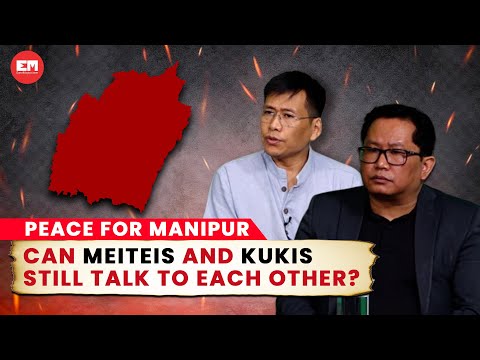
The violence in Manipur has pushed many left-liberal-secular leadership and intelligentsia to a corner. Even the right-winged Indian nationalists and their spin doctors are made to see the conflict from the prism of Tribal versus Non-Tribal communities, Majority versus Minority, Hindu versus Christian communities etc. There is another reality – very few take the geopolitical angle seriously or even the transnational slant associated with the issue. One needs to understand the fact that Manipur has been dogged by protracted militarisation for the last many years owing to what the Indian state termed insurgency or ethnic terrorism. For such a sensitive region in the far east of India, certain imperatives seem to have been rolled out by New Delhi. However, conjectural, these steps are not conducive to the mutual collective living of the many ethnic groups in the entire northeast region of India. Hence, the feeling of persecution is being felt by both ethnic groups seemingly at war now.
This is why, attempting to understand the current volatile situation in Manipur calls for acknowledging at least four elements – first the local dynamics, including the spate of inter-ethnic violence between the Chin-Kuki-Zo communities on one side and the Meitei community on the other; Second, the origin of the tension; Thirdly, narco-politics, lastly and most importantly India’s strategic cross-border interests and India’s geopolitical interests in its Northeast region and Southeast Asia. The four elements are the key to unravelling the overall multi-layered issues.

Local Dynamics
As palpable tension still prevails over the hills and valley of Manipur, what has happened since May 3, 2023, needs to be structured into a narrative without the myopic, sectarian, propagandist bias or even rumours or hear-says being floated around that have further fuelled irreversible ethnic friction. A good description of the incidents of ethnic violence that have engulfed Manipur also needs certain exposition and a newer perspective based on streamlining the popular narratives based on a truncated sequence of events. The first thing that one needs to understand is how did all the killings, arson, mayhem and destruction happen so fast and how an informed citizen is left gasping for a reasonable rational story.
Every informed citizen knows there had always been ethnic fault lines in the strategically located region called Northeast India. The factual manifestation of these fault lines includes the most recent violent clashes between people belonging to Chin-Kuki-Zo hill tribes and the Meitei community in Manipur.
So far, there is no exact official confirmation of the number of casualties in the ethnic conflict in Manipur. However, it has been reported that by July 10, 2023, 142 people were killed and 17 were missing. The number must be higher now as authorities discover new casualties whose whereabouts were not known earlier or people who have been killed since the arrival of central security forces.

Over 45,000 people belonging to both ethnic groups have been shifted to relief centres and homes in both the valley districts and the hill districts of Manipur. Many of the survivors of the violence were evacuated by security forces under tremendous difficulties. Reports coming in from Mizoram as on May 17 say that internally displaced persons from Manipur crossed the 6500-mark in the neighbouring state.
According to state security forces, the spate of violence began when an armed mob infiltrated a tribal solidarity march held in protest against the demand for the inclusion of the Meiteis into the list of Scheduled Tribes under the Indian Constitution. Though the rallies were held in all the hills districts of Manipur, trouble started in the Torbung near Churachandpur. The armed mob reportedly burnt down the houses of the Meitei community and destroyed their homes and properties during the May 3 tribal solidarity march. This led to retaliatory attacks in the valley districts of Manipur where the Meitei community is dominant.
Separate Administration Demand by Chin-Kuki-Zo MLAs
As mud-slinging and blames games begin, 10 Members of the Manipur Legislative Assembly (MLA) hailing from constituencies dominated by Chin-Kuki-Zo hill tribes who had earlier extended unstinted support to the N Biren Singh-led BJP government have sought a “separate administration” under the Constitution of India. This they say can only be possible after parting ways with the Manipur government.
The ten MLAs that included five from the Bharatiya Janata Party (BJP) on Friday (May 12) labelled a serious allegation that the widespread violence was “perpetrated by the majority Meitei community and was tacitly supported by the BJP-run state government. “As the state of Manipur has miserably failed to protect us, we seek from the Union of India a separate administration under the constitution of India and live peacefully as neighbours with the state of Manipur,” the MLAs said in a statement considered an embarrassment to the N Biren Singh led state government.

The MLAs are Haokholet Kipgen, Ngursanglur Sanate, Kimneo Haokip Hangshing, Letpao Haokip, LM Khaute, Letzamang Haokip, Chinlunthang, Paolienlal Haokip, Nemcha Kipgen and Vungjagin Valte. All of them belonged to the Chin-Kuki-Zo hill tribes. Of these, Chinlunthang and Hangshing belong to the Kuki People’s Alliance and the rest to the BJP, JD (U) and one Independent. So in a sense, this could be read as a fight between the BJP and its supporters in Manipur. The statement of the MLAs further alleged that the violence against their communities has “already partitioned the state and effected a total separation from the State of Manipur”.
Rejection of Allegations by 10 MLAs
In response to the violence, tension and the statement of these ten MLAs, the government of Manipur did not officially react to the demand of these ten MLAs. However, the Meitei Resurgence Forum (MReF), a civil society organisation had accused the 10 Kuki MLAs of stating the shadow of the minority tag without mentioning anything about the Meitei victims who incidentally belonged to the majority community.
Dismissing the popular perception of the majority versus minority conflict, MReF said that the present violent episode has been instigated by select groups responsible for bringing in “narco-terrorism” unleashed by the Kuki groups under the Suspension of Operation (SoO) (a localised tripartite ceasefire signed between the Government of India, the Government of Manipur and the Kuki armed groups) “at the behest of …. drug mafia, politicians, intellectuals and frontal organisations”. The forum, in equal terms, condemned the aggressive response of the mob comprising of Meiteis that has led to violence, destruction of Kuki houses and property and vandalisation of structures of worship in Imphal valley areas. However, the most significant allegation raised by MReF includes directly implicating the armed Kuki militants “funded by drug money and illegal migrants from Myanmar, Mizoram and Bangladesh.”

An Origin Split Wide Open
While tracing the origin of the issue, one does not have to travel back far in history. It has been amply clear that there is a connection between ethnic violence, narco-economy, national security and international military strategy.
While the ethnic tension still prevails in the hills and the valley of Manipur, it should be noted that the government of Manipur had been pursuing its “war” against the illegal drugs trade by constantly arresting all those who are allegedly involved. Even village chiefs under whose jurisdiction poppy cultivations are on a large scale in the hills were arrested. The government had also been arresting hundreds of drug pushers and peddlers. But most of the time, suspected kingpins and drug lords had their ways to escape the state’s pursuit. Due to this, the effort of the state government had not been appreciated by the common people as most of the time, the arrests made so far have not been able to trace the king-pins or drug lords both from the hills or valley who had invested a huge amount of money in the illegal trade.
Despite the widespread but hushed-up criticism, and while the current tension was at its peak in violence-affected areas, Narcotics and Affairs of Border (NAB) — a specialised unit of the State police on May 8 seized 77 gunny bags, suspected to contain poppy seeds and Myanmar’s currency notes in the Mantripukhri area of Imphal city. It has been reported that the house from where the contraband items were seized belongs to an international drug cartel.
After a keen observation of the unfolding situation in Manipur, it can be correctly assessed that the anger of the Chin-Kuki-Zo hill tribes had been fuelled by a series of actions taken by the N Biren Singh government, including its much fancied “war on drugs”, and subsequent eviction of residents of villages in the hill areas identified by the government as reserved and protected.
According to Manipur government sources, between 2017 and 2018, over 18,664 acres of poppy-cultivated land have been destroyed by the state forces. This destruction of poppy cultivation has been confined to mostly the hill districts. Between 2013 and 2016, only 1,889 acres of poppy-cultivated land were destroyed.

While talking about poppy cultivation, one can recall how the issue was raised by a Congress Member of the Legislative Assembly (MLA) Kangujam Ranjit Singh during the opening day of the Second Session of the 12th Manipur Legislative Assembly Session on July 25, 2022. The MLA urged the members of the house to enact a stringent law that can award capital punishment or life imprisonment to the lawbreakers arrested in connection with the illegal drug trade. He was echoing the exact feeling of the average informed citizen in Manipur who has been weighing the sheer vainness of official campaigns undertaken by the state apparatus.
The MLA while trying to project the palpable despondency of the people on the “war on drugs” remarked that a few years ago, drugs seized in Imphal Airport, Pallel or other areas of Manipur were mainly trafficked from the Golden Triangle countries like Laos, Thailand and Myanmar but now, the drug is manufactured in Manipur itself. He then pointed out how the hill areas of Manipur have been denuded to make way for mass poppy plantations for the onward production of contraband drugs. He emphasized that the Narcotic Drugs and Psychotropic Substances Act, 1985 or NDPS Act, 1985 has not been able to curb drug smuggling in the state of Manipur.
Dear Reader,
Every day, our team at EastMojo travels through rain, rough roads, and remote hills to bring you stories that matter – stories from your town, your people, your Northeast.
We do this because we believe in truthful, independent journalism. No big corporate backing, no government pressure – just honest reporting by local journalists who live and breathe the same air you do.
But to keep doing this work, we need you. Your small contribution helps us pay our reporters fairly, reach places others ignore, and keep asking the tough questions.
If you believe the Northeast deserves its own fearless voice, stand with us.
Support independent journalism. Be a Member.
Thank you,
Karma Paljor
Editor-in-Chief, eastmojo.com


Kangujam Ranjit Singh while lauding the BJP-led government’s “war on drugs” campaign as it was receiving support from different communities and tribes, unequivocally remarked that despite an endorsement of the campaign by some community leaders could not halt mass poppy plantation in the state. While the concerns raised by the MLA in the august house too hit the front pages of many state and regional dailies, one feels that there is still the need to ponder on the issue taking into consideration the global drug economy. When the MLA referred to the Golden Triangle countries like Laos, Thailand and Myanmar, he was speaking the obvious.
Views expressed are personal. The author is the Editor-in-Chief of The Frontier Manipur. This article is taken from a speech he delivered during the N Narendran Memorial Lecture on August 7, 2023 at the Thiruvananthapuram Press Club.
Also Read | Manipur: Is separate administration inevitable?