

This is the first of a two-part series on how corruption led to the dam disaster in Sikkim and how expert recommendations were repeatedly ignored by the Pawan Chamling government. In Part two of the series, we look at how hydropower, once touted as the biggest resource of Sikkim, turned out to be its bane.
A shoddy consortium, hefty debts and a design that proved to be catastrophic: over 36 years since the Teesta III dam was first proposed, it has come to only spell disaster for the state of Sikkim.
In the Northeast (whose hydropower potential was estimated to be about 40% of the total hydropower potential identified in the country), Sikkim ranked second after Arunachal Pradesh in terms of “exploitable potential”. The trajectories of the state’s two main rivers Teesta and Rangeet that form at higher altitudes and flow in a general southern direction make them ideal for hydropower generation.
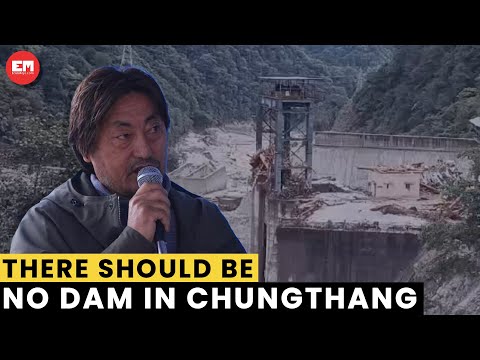
After three delays, an earthquake and a slew of financial troubles, the Teesta-III was finally operational in 2017. Six years later, however, disaster struck and the dam was completely submerged, leaving behind debris and an insurmountable debt for the small state.

Through reports of the Comptroller and Auditor General of India and documents of the Sikkim government, which EastMojo accessed, here’s a timeline of everything that went wrong with Teesta III.
And it started years ago.
Commissioning of Teesta III
In 2005, a writ petition was filed in the Sikkim High Court over the agreement signed between the State of Sikkim and Teesta Urja Ltd (now Sikkim Urja Limited), the special purpose vehicle, for setting up Teesta Stage III. The petitioners, one of which was the former Sikkim Chief Minister Nar Bahadur Bhandari, laid out the “undisputed factual matrix.”
The 1200 MW Teesta Stage III Hydropower was first conceptualised in the Central Water Commission’s Project Report in 1987. Initially, the National Hydro Power Corporation, a public sector hydropower company run by the Government of India, was roped in to execute the project with the Government of Sikkim.

After the GoI’s liberalisation move in 1991, the Sikkim government withdrew its original proposal with the NHPC and instead invited private parties to bid on the project.
But 6 years passed and the project failed to get attractive bids that would benefit the state. By 2003, the new Electricity Act was passed, which “facilitated [the] development of Hydropower projects liberally”.
The Sikkim state cabinet then led by Pawan Kumar Chamling decided to fast-track efforts to tap the hydropower potential in the state. A High Powered Hydro Power Committee was constituted, which recommended 13 projects, including the Teesta Stage-III.
On 22 February 2005, the Sikkim state cabinet approved the development of the Teesta III Hydropower Plant. The project was awarded to a consortium led by Athena Project Pvt Ltd on a ‘Build, Own, Operate, and Transfer’ (BOOT) basis under a joint sector with the state government.
A company under question
The Delhi-based Athena Projects Private Limited (APPL), formerly known as Athena Advisors Private Limited, was incorporated on 5 August 2004, a little over six months before it was brought on for executing the project.
The High Power Committee constituted by the state government had helped prepare a draft of the state hydropower policy that had been approved in October 2004.
“Out of the five offers received, only one offer received from the consortium led by Athena Projects Private Limited, India (Athena India) fulfilled all the conditions of the State hydro power policy,” the 2015-2016 Comptroller Auditor General’s report stated.

The proposal of the Athena India-led consortium had focused on “the technical experience of four consortium members in the field and also regarding financial and project management capabilities of the consortium members.”
APPL became the leader of a consortium that included several other entities including Andhra Pradesh Power Generation Corporation Limited (APGENCO), Larsen & Toubro (L&T), Power Trading Corporation (PTC), ICICI securities, IL&FS, Karvy and Halcrow & Colenco.
A document of the Sikkim government accessed by East Mojo disclosed: “The Letter of Intent (LOI) was issued to M/S Athena Project Pvt Limited (APPL) on 26.02.2005 without State Cabinet or GoS [Government of Sikkim’s] approval.” As per the document, APPL “had zero net worth, zero experience, had no finance and expertise in the execution of the project of such magnitude”.
The document notes that APPL changed its name from Athena Advisors Private Limited, just 54 days before the Sikkim government issued it a Letter of Intent. In addition to this, “no consortium agreement was signed among the members of the so called ‘Athena Consortium’”.
Also, while APPL didn’t have any experience in implementing the project, “three out of these four consortium members (excepting Power Trading Corporation of India Limited) having technical experience in the field had exited from the consortium without the prior permission of the State Government [as set in the Deed of Agreement with TUL],” according to the 2015-2016 Comptroller Auditor General’s report.
In March 2005, the special purpose vehicle formed by Athena India to implement the project, the Teesta Urja Limited (TUL) was incorporated.
An earlier report by EastMojo highlighted the many violations by TUL to the Memorandum of Agreement of Memorandum of Understanding signed between the state government and the TUL.
The report also highlighted how in an internal correspondence the Sikkim government had admitted that the letter of intent (LOI) issued to Athena for the construction of the Teesta Stage III 1200 MW project, was the State’s hydropower policy.

According to the Deed of Agreement signed between the state government and TUL, TUL would operate the project for 35 years, after which it would be transferred back to the government. “During the period of 35 years, State Government would receive a royalty in the shape of free power at 12 percent of the net generation from the project for the first 15 years of operation and 15 percent of free power during 16th to 35th year of operations,” the CAG report noted about the conditions set in the DoA.
Additionally, “Athena India consortium and the State Government were to contribute towards project funding (including escalations in the project cost) in the form of equity contribution in TUL’s capital in the ratio of 74 per cent (Athena India consortium) and 26 per cent (State Government) respectively.”
IPPs or Independent Power Producers are responsible for developing hydropower projects that have a capacity of more than 25 MW.
“Failure of the State Government to have pre-bidding conditions to verify the financial capability and experience of the consortium leader and also to ensure adherence to the agreement conditions by the private consortium had forced the State Government to take over (August 2015) the project through equity infusion in the capital of Teesta Urja Limited (TUL) besides causing time overrun of more than four years in completion of the project,” the 2015-2016 Comptroller Auditor General’s report states.
In 2007, the “works of the project” (Engineers Procurement and Construction contract) were awarded to Abir Infrastructure Pvt. Ltd. (ABIR) & consortium. The earlier EastMojo report also highlights how ABIR and TUL had the same shareholders and how in 2010 the Singapore-based Asian Genco Private Limited had come to acquire a majority stake in TUL in violation of the state government’s Deed of Agreement with TUL.

In 2012, the Sikkim government moved the High Court over being denied 26% equity. Following this, board members of TUL approved the transfer of Rs 30 crore in the 26% stake. A shareholding agreement was signed between the shareholders of TUL and the Sikkim government.
The CAG report 2015-2016 states: “It was observed that the equity subscription agreement was actually executed (March 2008) by the TUL after a delay of more than 2 years. In the meantime, the financial closure for the project was also achieved by TUL in September 2007. It was, however, observed in [an] audit that the State Government had contributed towards its share (26 per cent) in TUL’s equity capital only during April-December 2012.” As a result, there was no representative of the state government on the Board of Directors of TUL till 2011, which “had adversely impacted the monitoring of the project related activities.”
Of disaster and delays
The Teesta III project was expected to be completed and commissioned by 2011-2012 at an estimated cost of Rs 5,700 crore.
In 2006, TUL got the required Techno Economic Clearance (TEC) from Central Electricity Authority (CEA). Construction of the project started in January 2008.
Then in September 2011, disaster struck – an earthquake of 6.9 magnitude near the border between Nepal and Sikkim. It claimed the lives of over 100 people, made entire buildings collapse and destroyed villages.
Work on the Teesta III dam was halted.
“Due to an earthquake (18 September 2011) and collapse of Rangchang Khola bridge (December 2011), the TUL was granted extension of commercial operation date (COD) from September 2012 to December 2013,” the CAG report states.
Further, the report states that “due to controllable and uncontrollable reasons” the project was delayed leading to three cost overruns.
The revised cost after the first overrun was Rs 2,881 crore over the initial total project cost bringing it to Rs 8,581 crore. According to the document accessed by EastMojo: “The reason…as specified in white paper are no access to “no access to project component, design changes, geological surprises in underground works, floods and landslides, impact of Gorkhaland movement, escalation of prices of major items, increase in rate of interest, levies and taxes, massive earthquake in September 2011 that led to stoppage of works, collapse of bridge enroute to project site in December 2011, stoppage of work due to flash flood in Sept 2012”.
The second time the cost overrun occurred was in June 2015.
The reason: “contractor claim including arbitration award, increase in BOQ (Bill of Quantities), change in design of diversion tunnel outfall, change in design and specification of RIM protection works, increase in taxes due to change in law, increase in IDC (interest during construction) due to shifting of project schedule etc.,” the document states.

The second cost overrun was an additional Rs 2801 crore bringing the total project cost to Rs 11,382 crore.
“Athena India consortium also failed in meeting their committed financial obligations towards funding of the project for second cost overrun in violation of the agreed terms of DoA,” the CAG report states.
Work stopped once more from June 2014 till September 2015 due to fund constraints.
In 2015, the Share Purchase Agreement between TUL and GoS was executed “to enhance the GoS [through Sikkim Power Investment Corporation Limited] holding from 26% to 51%”, the document states.
The third cost overrun in 2015 saw the project cost increase by Rs 2,583 bringing the total cost of the project to Rs 13,695 crores – a 245% rise from the initial estimated cost.
| Cost component | Original cost (in Rs cr) | Revised cost after 1st overrun | Revised cost after 2nd overrun | Revised cost after 3rd overrun |
| Hard Cost (except financing costs) | 4,941 | 5,841 | 7,150 | 7,849 |
| Soft Cost (all financing costs) | 759 | 2,740 | 4,232 | 6,116 |
| Total | 5,700 | 8,581 | 11,382 | 13,965 |
Mounting losses and debt
The most recent CAG’s State Finances Audit Report for 2020-2021 had noted that the accumulated losses of State Public Sector Enterprises (SPSEs) in the last three years prior to 2021 had “shown an increasing trend”.
Losses were recorded at ₹ 2,753. 39 crore as on 31 March 2021. “More than 98 per cent (₹ 2,709.24 crore) of the accumulated losses of SPSEs (₹ 2,753.39 crore) during 2020-21 were contributed by Teesta Urja Limited (₹ 1,498.26 crore) and Sikkim Power Investment Corporation Limited (₹ 1,210.98 crore),” the report noted.

According to a document of the Sikkim government accessed by EastMojo, till June 2019, key officials of TUL were being paid hefty salaries. For instance, the then Managing Director, Shiv Kumar Aggarwal, was earning a salary of over Rs 2 crore per annum. In 2019, the salaries of six TUL officials were restructured leading to a net saving of Rs 3.5 crore per annum.
According to the document, the Sikkim government had borrowed Rs 2,898.97 from the Power Finance Corporation (PFC) towards the equity infusion in TUL (which by 2017 stood at 60.08%).
| SI No. | Loan No. | Sanctioned amount (in Rs cr) | Outstanding as on 31/3/2023 |
| 1 | 49339A01 (Teesta – III HEP) Debt – A | 2619.24 | 2898.97 |
| 2 | 49339A02 (Teesta – III HEP) Debt – B | ||
| Teesta – III PFC Loan | 2619.24 | 2898.97 | |
| 3 | 49339C01 (Rangit – IV HEP) | 81.23 | 0 |
| 4 | 49303001 (Chuzachen HEP) PFC | 72.55 | 0 |
| PFC Loan (A) | 2,773.02 | 2898.97 | |
| 5 | State Bank of Sikkim | 184.28 | 338.49 |
| 6 | Power Department | 1.85 | 24.99 |
| 7 | Land Revenue Dept | 2 | 0 |
| Other Loan (B) | 188.13 | 363.48 | |
| Total Loan (A+B) | 2961.15 | 3262.45 |
The Government of Sikkim is also fully guaranteed for payment of TUL’s loan amounting to Rs 6,800 crore.
Design of dam
Teesta Urja Limited changed the dam’s original design that would endanger “the safety of the dam” without seeking prior approvals, a team from the Central Electricity Authority (CEA) had found back in 2008.
These observations were noted in the minutes of a meeting of the Expert Appraisal Committee for River Valley and Hydroelectric Projects from 2009: “The Committee observed that a major matter of concern is adoption of a Concrete Face Rockfill Dam (CFRD) with Diversion Tunnels (DT) modified to function as spillway. The altered arrangement of adopting the DTs which can discharge only 3000 cumec is definitely an unsafe proposition for this major 1200 MW power project.”
The spillway in a dam is used to control the amount of floodwater that can be released by a dam.
It further stated, “The Committee further observed that a rock fill dam with inadequate spillway capacity faces the risk of overtopping, which leads to Dam Break: a catastrophic proposition as five major schemes Teesta IV, V, VI and two low dams are planned/ constructed on the river downstream.”
Dear Reader,
Every day, our team at EastMojo travels through rain, rough roads, and remote hills to bring you stories that matter – stories from your town, your people, your Northeast.
We do this because we believe in truthful, independent journalism. No big corporate backing, no government pressure – just honest reporting by local journalists who live and breathe the same air you do.
But to keep doing this work, we need you. Your small contribution helps us pay our reporters fairly, reach places others ignore, and keep asking the tough questions.
If you believe the Northeast deserves its own fearless voice, stand with us.
Support independent journalism. Be a Member.
Thank you,
Karma Paljor
Editor-in-Chief, eastmojo.com


“First and foremost when we were protesting in 2005 we went through all the documents. There was no mention of glacial studies in EEMP (WIFOS). Moreover, the dam is almost impossible,” he said and added, “No matter what kind of dam you make it will not stand because of the topography.”
On October 4 2023, the ‘prediction’ came true: the 60-metre-high dam was washed away by a glacial lake outburst flood.
Also Read | EM Impact: NGT issues notice to Sikkim authorities for dam breach