

In December 2021, Vanramchhuangi, also known as Ruatfela Nu, sat at her desk in Aizawl with a pendrive in her hand and a thought she could not shake loose: I don’t want to do this anymore.
She had spent two years gathering documents, visiting Champhai, writing articles, and trying to build a case against what she had come to see as one of the most damaging criminal enterprises in Mizoram’s recent history, the smuggling of areca nuts from Myanmar, running freely through the hills of Champhai district with the apparent knowledge and silence of the state’s own police force.
The documents alone weighed 8.8 kg. Her senior had spent two years on the fight before her. She had filed an FIR that was not registered. She was simultaneously running an environmental movement. She was exhausted.
“Mafak, I don’t want to do this anymore, let’s just not file it,” she told C. Lalfakzuala, the colleague who had been pushing her to move the Gauhati High Court with a Public Interest Litigation.
His response kept her going. “What you are doing is important not only for our nation but for the farmers and betel nut workers of our community. Keep going steadily.” So, she filed the PIL.
What followed over the next three years, a High Court order, a CBI investigation, a chargesheet naming 21 accused, and, most recently, Enforcement Directorate raids across nine locations in Champhai, is the story of how one woman, working largely alone, brought down what investigators now describe as a Rs 970-crore smuggling racket that had operated unchecked for over a decade.
A Racket in Plain Sight
The smuggling of dried areca nuts from Myanmar into India through Mizoram’s Champhai district is not a recent problem. Areca nuts came across the border by handcart and small vehicle, then came the trucks.
By 2018 and 2019, large 12-wheelers were making regular runs from Zokhawthar, Mizoram’s land customs station on the India-Myanmar border, into the Indian heartland. One guard stationed at the border told farmers he spoke to that on average a single 12-wheeler truck made 50 to 80 such trips in a month.
Inferior quality areca nuts from Indonesia, Thailand, and Myanmar, stored in villages just across the Tiau River in Myanmar, were smuggled across the border without customs clearance.
On reaching Champhai, the consignments were repackaged and issued transit permits by the Mizoram Agricultural Marketing Corporation (MAMCO), certifying them as produce of Mizoram’s own farmers. From there, fraudulent e-way bills and forged GST documents enabled the goods to cross state borders as legitimate Indian agricultural produce.
The numbers that have emerged are staggering. Between 2021 and 2024, fraudulent e-way bills worth Rs 251.19 crore under SGST and Rs 86.25 crore under CGST were generated in Champhai alone, according to the ED.
Over the 13-year period from 2013 to 2025, proceeds of crime amounting to approximately Rs 970 crore were routed through multiple accounts.
The operation was financed by traders based in Silchar, who transferred funds through banking channels; payments to Myanmar suppliers were made in Indian currency converted through money exchangers near the border. Local facilitators in Mizoram earned commissions of Rs 2 to Rs 15 per kilogram.
The customs duty on areca nut imports is 100%, with an additional 5% IGST, making the total import duty 105%. Evading that duty on the volumes being moved was a business model in itself.
“I saw that the illegal cross-border betel nut trading was not only harming the environment. It was seriously damaging human lives, family lives, and community lives,” Vanramchhuangi told EastMojo. “Champhai district seemed to be living like Mexico, Colombia, Afghanistan, or like our neighbouring Burma, where illegal trade had become the way of life, where if money could be made, nothing else mattered.”
The Farmers Who Paid the Price
While the smugglers grew wealthy, the people paying the price were hundreds of kilometres away in Mizoram’s Hachhek constituency in Mamit district, a belt of 34 villages where, for three generations, 80% of the population had earned their livelihood from areca nut plantations. Their struggle was documented by EastMojo in November 2022.
The people of Hachhek had started growing areca nuts since the 1960s. After their mandarin orange orchards were wiped out by Asian citric psyllids in the mid-1990s, farmers had collectively pivoted to areca nut cultivation. By 2020, the constituency’s farmers were earning over Rs 14 crore a year from the crop. The projections for future years were even more optimistic.
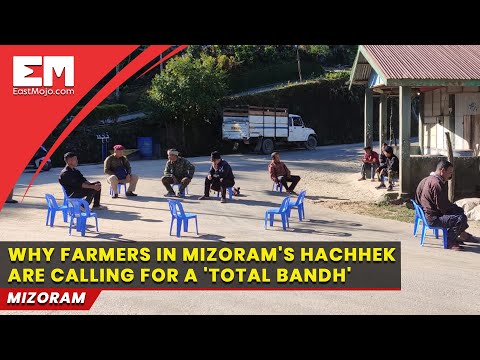
Then the smuggling boom destroyed their market.
ZR Lalthlanmawia, a farmer from Kawrthah who had been engaged in areca nut farming for around 15 years, had previously seen profits of around Rs 4 to 5 lakh per year from his farm. In the year the crisis peaked, he made zero profit.
The mechanism of ruin was indirect but devastating. The Assam government, responding to Union Home Ministry directions to curb areca nut smuggling in 2019, had tightened border checks.
But because the smugglers had successfully blended their goods with legitimate Mizoram produce, using the same transit documents, the same routes, the same middlemen, Assam’s checks could not distinguish genuine Hachhek areca nuts from smuggled Myanmar stock. The result was an effective blockade on all Mizoram areca nut consignments.
Areca nut is a time-sensitive crop. After December 15, the fruits fall on their own. Farmers who could not sell faced not just a bad season but a total loss.
Also Read | Mizoram: How smuggling broke the back of Hachhek’s areca nut farmers
“Around 948 families had zero sales because of the current issue, and over 5,000 lives were affected,” a representative of the Hachhek Bial Kuhva Chingtu Pawl (HBKCP), the umbrella body of betel nut grower societies in the constituency, told EastMojo. “We might have to call our children home if the situation continues like this.”
Kanan Lalhlimawma, the HBKCP’s assistant secretary, whose grandfather was among the seven people who first brought areca nut seeds to the region, described sleepless nights during harvest season. “We were really happy we chose betel nut cultivation as our livelihood, and we did not face any major problems, until now. November is the month for us to harvest our produce, so we have started spending sleepless nights,” he told EastMojo.
The farmers had done everything they were supposed to do. They had met Mizoram Chief Minister Zoramthanga. They had written to the Home Minister.
They had travelled to Assam to meet Chief Minister Himanta Biswa Sarma. They had submitted a memorandum to the President of India. They had picketed roads for a month, 24 hours a day, to prevent their areas from being used as smuggling routes.
Lalthlanmawia recalled an incident where he and some friends, while on night duty checking for illegal transport, stopped a truck carrying smuggled areca nuts.
The driver told them that a Superintendent of Police had personally called the duty personnel at the checkpoint and cleared the truck. “High-ranking police officials and district officials are involved. Otherwise, there would be no chance for these trucks to pass through freely,” he told EastMojo. “Even the police told us they have given up. They see no meaning in seizing the smugglers as higher-ranking officials release them.”
This collusion reached even into the district administration. A magisterial investigation report filed in December 2021 by Executive Magistrate Esther Leihang to the Champhai District Magistrate recorded that police at the Khankawn checkgate told her that movement of smuggled areca nuts could not be stopped at their level, because they had received instructions from Police Headquarters in Aizawl to allow vehicles to pass. The district magistrate’s authority to carry out her lawful functions was being neutralised from above.
A PIL No One Wanted to File
Vanramchhuangi, who founded the Human Rights and Law Network in Mizoram and is widely known by the sobriquet ‘Ruatfela Nu’, had been tracking the smuggling since 2020.
She had built her case from multiple sources, a letter from the Karnataka State Arecanut Marketing Federation to the Ministry of Home Affairs that first flagged the racket; Myanmar Ministry of Commerce trade records showing that official trade volume into Mizoram through Zokhawthar was recorded at a mere 164 USD worth of goods over a full year, against an estimated informal areca nut trade of Rs 2,500 crore.
She had also visited Champhai personally, interviewed residents, and documented the illegal roads being carved through forests by excavators to create new smuggling routes.
The environmental destruction, trees felled, agricultural land damaged, and streams disrupted, was her first point of entry into the fight. But the more she looked, the more the human cost became visible.
On 28 December 2021, she filed an FIR at Champhai Police Station, urging an investigation into the fabrication of GST documents and tax evasion. The FIR was not registered.
“It was deeply disappointing, but without losing heart, I filed a PIL at the Gauhati High Court,” she said.
She had to navigate this largely on her own resources. PIL cases in Mizoram, she noted, are expensive, and few lawyers are willing to take them on. “Among Mizo lawyers, PIL cases are ones many do not want to handle. The case is expensive, and because it is a PIL, they are reluctant to charge fees.”
When she had previously filed a PIL on civil hospital land encroachment, her legal fees had run to Rs 1.5 lakh, with similar sums spent at the National Green Tribunal and Supreme Court for environmental litigation.
This time, advocate Lalfamkimi Kawlni translated every document, the petition, her RTI applications, and her memorandum to the Chief Minister, from Mizo into English, labelling every file.
“My collected documents, weighing 8 kg 800 grams, like a student preparing for a lawyer’s exam, she organised everything for me,” Vanramchhuangi wrote. C. Lalfakzual, who had previously won a PIL on road conditions in Bawngkawn-Durtlang, stood up for her at no cost.
The PIL, numbered PIL No. 5/2022, was filed at the Aizawl Bench on April 29, 2022. Its prayers were specific: investigate the tax fraud, protect Mizoram’s legitimate areca nut farmers, and, because Mizoram police had proven unable or unwilling to act, transfer the investigation to the CBI.
What the Court Found
When the Gauhati High Court examined the numbers, the discrepancies were damning. The Directorate of Horticulture, Government of Mizoram, had officially reported a total areca nut production of 33,540 metric tons for 2019-2020.
The Directorate of Arecanut and Spices Development, however, reported only 10,840 metric tons for the same period, and crucially, reported zero production in Champhai district specifically. Yet e-way bills were being generated in Champhai for areca nut consignments on a massive scale.
Champhai’s own climate makes the discrepancy self-evident. The district’s temperature ranges between 10 and 20 degrees Celsius in winter and 15 to 30 degrees Celsius in summer, conditions unsuitable for areca nut cultivation.
There are also no drying or processing units in the state to justify the GST classification being used. The nuts being documented as Mizoram produce simply could not have been grown in Mizoram.
The Customs (Preventive) Division’s affidavits submitted to the court documented numerous seizures of smuggled areca nuts from 2017-2018 through June 2022, seizures that had generated no meaningful criminal action.
State police had declined to register the petitioner’s FIR on the grounds that it concerned a non-cognizable offence. Vanramchhuangi countered that the fake GST invoices fell squarely under cognizable sections of the IPC, including Sections 420, 468, and 120B.
In July 2024, the Gauhati High Court ordered the CBI to investigate.
“As I requested, the HC issued a judgment ordering CBI investigation,” Vanramchhuangi wrote. “Shortly after the HC order, CBI immediately began investigating. My FIR filed at Champhai, which the police had refused to register, the court also directed to be registered. Having clearly understood that Mizoram police could not be trusted in betel nut smuggling matters, I stopped monitoring what Mizoram police were doing and watched what CBI would do.” CBI arrived in Zokhawthar within days of the order. Their investigation covered the period from January 2021 to March 2024.
The Chargesheet and What Came After
On 29 August 2025, the CBI filed its chargesheet. Twenty-one persons were accused. The transactions involved amounted to approximately Rs 1,022 crore. The tax evasion, the customs duty and GST that should have been paid to the Indian exchequer, amounted to approximately Rs 408 crore.
Put differently, the transactions involved represented roughly 7% of Mizoram’s annual budget. The evaded taxes amounted to approximately 3% of the state budget, disappearing entirely into the pockets of the smuggling network.
“I consider this a truly remarkable development,” Vanramchhuangi said. “From what I have experienced and know, CBI acted far more swiftly than Mizoram’s ACB ever did. Mizoram police had been very negligent.”
On 10 November 2025, a court date was held for the delivery of documents. Seventeen of the 21 accused appeared before the court immediately. One had absconded. Three had not yet engaged lawyers. Once the document delivery process is complete, the criminal trial will formally begin.
In June 2026, the Enforcement Directorate conducted searches across nine locations in Champhai under the Prevention of Money Laundering Act.
Investigators alleged that the smuggled consignments were transported from border warehouses to Vairengte on the Assam-Mizoram border, financed by traders in Silchar who transferred funds through banking channels. The ED’s analysis put total proceeds of crime at Rs 970 crore routed through multiple accounts over 13 years, from 2013 to 2025.
The Price of the Fight
Vanramchhuangi talked to EastMojo about what the years-long battle cost her. “I faced pressure both internally and externally. I kept retreating, I almost gave it up.”
She describes the social isolation that comes from taking on powerful, locally embedded interests, connections pressured and doors that stopped opening.
She speaks with particular warmth about IAS officer Maria CT Zuali, who, as Deputy Commissioner of Champhai, had taken strong action against illegal areca nut trading before being transferred in January 2022, a transfer that various trade unions publicly protested, and that one truck owner triggered by filing an FIR against her.
“When she was DC of Champhai, we fought alongside each other greatly. I’m not sure whether I supported her or she supported me,” Vanramchhuangi said.
She is also forthright about the larger damage she believes the smuggling has done to Mizoram’s social fabric, damage that no chargesheet fully captures. The circulation of massive black money inflates real estate prices, making ordinary life harder for ordinary people.
Young men were drawn out of school by the easy money on offer. “In one town in Champhai district, many Class 10 male students dropped out of school to participate in betel nut smuggling. Even the lowest-level work paid well, and the school was facing a year with virtually no male students for the Class 10 exams. The headmaster went door to door pleading with students to come back,” she said.
The same pattern, she argues, feeds the drug economy. “When smuggling routes close, those who ran them will not seek honest work. They will not hesitate to smuggle heroin either,” she said, pointing to a village near the Burma border where, by recent accounts, a large proportion of households are now reportedly involved in heroin smuggling.
“This nation is sinking deeper and deeper into the love of money as the root of all evil,” she said. “How I wish it could come out.”
This story was produced with support from Report for the World, a global media service strengthening local independent journalism.
Also Read: Zero Revenge Killings: The mystery at the heart of India’s only successful Peace Accord

You just read a story that took days to report. Help us keep our reporters on the ground in the Northeast.
Ad-free reading, support and keep important stories alive
Support once (any amount)

Scan to pay via UPI