

Shillong: The Khasi Students’ Union (KSU) bike rally in Shillong on Wednesday descended into violence, with 31 government and private vehicles damaged, 16 people assaulted and statues of Netaji Subhash Chandra Bose and Swami Vivekananda vandalised, according to East Khasi Hills Deputy Commissioner Abhilash Baranwal.
Two vehicles, including one government and one private vehicle bearing registration numbers from outside Meghalaya, were also set on fire during the rally.
Strongly condemning the incidents, Baranwal said such acts had no place in a peaceful and civilised society and warned that the violence could have serious consequences for Meghalaya’s tourism sector and people from the state seeking employment outside Meghalaya.
“We strongly condemn the incident,” Baranwal said.
He said reports had also emerged of Meghalaya-registered vehicles being stopped and vandalised near Jorabat. The Meghalaya government, he said, was taking up the matter with the Assam government and administration.
Baranwal said the administration had been aware of apprehensions surrounding the rally and had deployed around 200 security personnel. However, given the length of the rally route, there were pockets where the deployment may not have been sufficient.
The administration would examine whether its response during the rally was adequate, he said, but stressed that permission to hold a protest did not amount to permission to assault people, vandalise property or indulge in arson.
“Permission to organise protests is not a permission to assault, to vandalise, to arson, to hurt children,” Baranwal said.
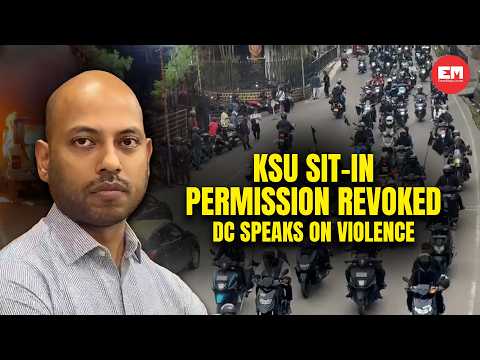
He said the conditions imposed while granting permission for the rally had been violated, making the gathering an unlawful assembly. The permission has consequently been revoked and an FIR registered.
Police have already apprehended three KSU leaders, while efforts are underway to identify those allegedly involved in the arson, vandalism and assaults.
Police, KSU clash at office
The arrests of KSU leaders were followed by a confrontation at the union’s office on Wednesday evening, with allegations of excessive use of force by police emerging alongside police claims that personnel were attacked with petrol bombs.
East Khasi Hills Superintendent of Police Vivek Syiem said on Thursday that police went to the KSU office to arrest members allegedly involved in the vandalism during the rally.
According to Syiem, police faced stiff resistance when they reached the office and petrol bombs were thrown at personnel, prompting them to use tear gas.

“Police went there to arrest some of the members who were involved in vandalism. But when the police went there then they were received with stiff resistance. Petrol bombs were thrown at the police for which they were forced to use tear gas just to disperse them,” Syiem said.
He said that after the crowd was dispersed, residents came out and requested the police not to escalate the situation. The police subsequently left the area, he said.
The police response came after former KSU president Lambokstarwell Marngar alleged that excessive force had been used when personnel entered the KSU office. Concerns were also raised about the impact of the operation on residents in the area and a nearby hospital.
Syiem said police had also received reports of assaults on personnel and vandalism during the unrest and had compiled details of injuries and damage caused during the incidents.
Meanwhile, KSU president Raymond Kharjana, general secretary Reuben Najiar and vice-president Pynkmenlang Sanmiet were produced before a court on Thursday morning and sent to 14 days’ judicial custody.
The three leaders have been booked under several provisions of the Bharatiya Nyaya Sanhita (BNS), including sections relating to unlawful assembly, assault and attempt to murder. The case also includes Section 3(2) of the Prevention of Damage to Public Property Act and provisions of the Meghalaya Maintenance of Public Order Act.
Questions over security and intelligence
Baranwal said the administration would examine whether its security arrangements during the rally were adequate.

He said the administration had received intelligence inputs ahead of the event, which was why strict conditions had been imposed while granting permission and security personnel deployed.
However, he said it was too early to describe the situation as a complete intelligence failure.
“Whether that intelligence was sufficient, whether that was disseminated timely, whether that led to clear understanding of the threats and the dangers is something that we need to examine,” he said.
“However, I wish that we could have done better, I wish that we had better intelligence,” Baranwal added.
He said the administration was also examining whether the violence had been pre-planned, part of a conspiracy, instigated or carried out by individuals who took advantage of the rally.
Responding to claims that unruly elements had hijacked the protest, the DC said that too would have to be established through investigation. He pointed to evidence of individuals carrying sticks and rods, covering vehicle number plates and wearing masks from the beginning of the rally.
Syiem, meanwhile, questioned whether the organisers had complied with the conditions attached to the permission granted for the protest.
He said police had deployed personnel at strategic locations after the organisers sought permission for the demonstration. However, several incidents of violence and vandalism occurred at locations where police were either absent or had limited presence, he said.
“The whole purpose of asking for permission is to follow the conditions,” Syiem said.
He said police had trusted the organisers to comply with the conditions, but that trust had been broken. If organisations failed to comply with conditions imposed by authorities, he warned, it could become difficult to grant permission for future protests.
16 assaulted, tourism concerns raised
Baranwal said the 16 people assaulted during Wednesday’s unrest had reported to Civil Hospital and received medical treatment. Sector magistrates had also been instructed to remain in touch with the hospital in case any of the victims required further medical care.
The DC warned that the violence could undermine Meghalaya’s efforts to establish itself as a national and international tourist destination.
He said the incidents could also have repercussions for people from Meghalaya who seek employment opportunities outside the state.
The warning comes amid concerns within the tourism sector over the impact of Wednesday’s violence, particularly incidents involving vehicles from outside Meghalaya.
Baranwal said the administration was taking the situation seriously and urged residents of Shillong and East Khasi Hills to cooperate with the authorities, report incidents promptly and refrain from spreading rumours.
August 21 sit-in permission revoked
The DC also confirmed that permission granted for the KSU’s proposed sit-in demonstration on August 21 would be revoked in view of the violence during Wednesday’s rally.
Five additional companies of the Central Armed Police Forces (CAPF), including one company of the Rapid Action Force (RAF), have been deployed in addition to the district police, Baranwal said.
The KSU had announced the sit-in at Khyndailad after its black-flag bike rally, which was organised to protest what the union described as the government’s failure to respond adequately to its 15-day ultimatum and charter of demands.
The rally was followed by widespread reports of stone-pelting, attacks on vehicles, assaults and vandalism at different locations across Shillong.
The administration has now begun efforts to identify those involved in the violence while the three KSU leaders remain in judicial custody.
Baranwal said the authorities would take action against those responsible in accordance with the law while stressing the need to protect the rights of peaceful protesters.
The events have also raised questions over the policing of large-scale protests and whether intelligence inputs were adequately assessed and acted upon before the rally.
For the administration, however, the immediate priority is to restore order and prevent further escalation.
Baranwal appealed to residents to cooperate with the police and administration and refrain from retaliatory action or the circulation of unverified information.
Also Read: Rupsi: History, erasure and the making of a borderland