

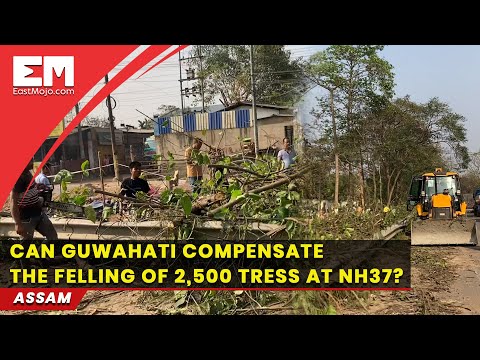
The proliferation of infrastructure projects in Guwahati, including flyovers, footbridges, and the reconstruction of official buildings, has raised concerns about the environment, governance, and public welfare. Reports indicate over 7,000 trees have been felled in Guwahati to facilitate these construction projects and reveal a gross underutilisation of funds for compensatory afforestation.
As these ongoing ‘development’ projects continue to contribute to rising temperatures, pollution levels, an increase in road accidents, and a decline in public health, the cost and limitations of such development are being called into question. On the other hand, essential development projects appear to be significantly overlooked, resulting in the city’s plight of enduring floods and landslides, while hundreds of thousands of individuals bear the brunt of yearly floods across the state.
Amidst the booming media coverage of climate change, it is crucial to recognise that the current development projects are often neglecting the crucial task of prioritising emission reduction and mitigating the impacts of climate change, as exemplified by the unplanned nature of Guwahati city.
In this particular context, it is important to note that the industrial climate mitigation strategies of Green Growth as focused in the Union Budget adhering to a growth-centric model, overlook the loopholes present in green energy technologies. A recent study on green energy technologies, a first of its kind, revealed that a 1% increase in green energy production depletes rare earth element (REE) reserves by 0.18% and increases greenhouse gas (GHG) emissions in the exploitation phase by 0.90%.
Between 2010 and 2020, the use of permanent magnets in green energy technologies resulted in 32 billion tons of CO2-equivalent GHG emissions globally, highlighting the unsustainable consumption of REE and the potential for significant emissions growth in the future as countries increasingly adopt green energy policies.
To put it simply, if a city is already emitting carbon and then undergoes growth in size as is the case of Guwahati, assuming all other factors remain unchanged, the amount of carbon pollution it generates will inevitably increase. It is high time that we reevaluate the underlying structural and sociopolitical dynamics and avoid absolution of their political origins of fundamental unsustainability.
The context of well-being revisited
The link between higher GDP or income and well-being is an issue of ongoing contention. Are the current growth models enough to address social and material inequality? Can we ignore the short and long-term negative impacts of such development projects on well-being?
The high growth rates of India over the past decades have been accompanied by high inequality, environmental costs, and low unemployment among others.

According to the Global Wealth Report 2022, wealth equality in India has increased significantly since 2000, as evidenced by the rise in the Gini coefficient from 74.6 to 82.3, the increase in the wealth share of the top 1% from 33.2% to 40.6%, and the decline in women’s wealth over 2020 and 2021. According to another recent report by Oxfam India, a mere 5% of Indians own over 60% of the nation’s wealth, while the bottom 50% of the population holds only 3% of the total wealth. Adding to that, Assam ranked among the lowest states in the SDG index, with particularly low scores in Goal 2 (Zero Hunger), Goal 3 (Good Health and Well-being), Goal 4 (Quality Education), and Goal 5 (Gender Equality), placing it at the 26th position among 36 states and Union Territories.
Focusing obsessively on income and material growth in development ignores important factors such as subjective well-being levels and the impact of social comparison. Studies have shown that economic growth doesn’t mean low-income individuals will necessarily experience increased happiness, as wealth distribution becomes more and more skewed (see here and here).
The current economic system, despite its systemic flaws, maintains its dominance and prevents historical examination and questioning of its fundamental structures. The popular Green Growth model alone is not a solution to these problems. It fails to address the root causes of unsustainability and inequities and fails to acknowledge the inherent contradiction between ecological limits and perpetual economic growth, as well as the differentiated experience of scarcity.
It is crucial to reconsider the affordability of growth in its current form, considering the displacement, dispossession, contamination, and loss of livelihoods faced by marginalised communities in the pursuit of growth, while environmental justice remains absent.

A shift in the development model?
The dominant developmental approach that perceives infrastructure projects as symbols of progress and modernisation falls short of recognising their inherent philosophical, relational, intersectional, and ecological dimensions. Debates on sustainability and the necessity for alternative approaches, such as degrowth, steady-state economy and post-development strategies, have arisen to align with core values of safety, justice, and equity.
Consequently, there is a growing demand for a rebalancing of developmental priorities which entails incorporating moral values, fostering community participation, embracing localisation, and considering heterogenous perspectives as possible solutions. This approach challenges the traditional linear growth-driven notion of development, which disregards qualitative well-being indicators and perpetuates the pursuit of material excess.
Postgrowth ideas in India have profound roots in the philosophies of Gandhian thought, theories by Rabindranath Tagore, Radhakamal Mukerjee, J.C. Kumarappa, and others, as well as in the actual practices of indigenous communities across the country. Despite the popular assumption that degrowth is primarily intended for the Global North, degrowth scholars frequently emphasise its potential to enhance people’s lives in Southern economies by proposing alternative approaches. Azad and Chakraborty criticising the exclusive application of degrowth principles to the developed global north, propose a combination of degrowth and decarbonisation as the fastest path forward.
The critique of degrowth applies to the global middle and upper classes, emphasising the necessity of reducing the living standards of the wealthy for achieving justice worldwide.

Returning to the case of Guwahati, the extensive felling of trees for construction in Guwahati has caused widespread concern and prompted protests against the destruction of green cover and biodiversity. However, protests and resistance must be able to move beyond short-term goals and address the underlying structural issues to challenge and replace exploitative systems. Ideas for theories of change need to come from all spheres equally. The responsibility for the same falls largely on civil societies.
Grassroots movements within the capitalist systems often face challenges as their initiatives can be co-opted, making an explicit anti-capitalist approach necessary to resist these tendencies and maintain focus on challenging and transforming capitalist structures.
Alternative development approaches beyond growth also challenge the traditional concept of the state, viewing it not as a rational and independent subject with an indisputable purpose, but as an evolving entity influenced by social forces and ideological struggles, where social change depends on shifts in everyday practices, ideas, and institutions of coercion and enforcement.

Dear Reader,
Every day, our team at EastMojo travels through rain, rough roads, and remote hills to bring you stories that matter – stories from your town, your people, your Northeast.
We do this because we believe in truthful, independent journalism. No big corporate backing, no government pressure – just honest reporting by local journalists who live and breathe the same air you do.
But to keep doing this work, we need you. Your small contribution helps us pay our reporters fairly, reach places others ignore, and keep asking the tough questions.
If you believe the Northeast deserves its own fearless voice, stand with us.
Support independent journalism. Be a Member.
Thank you,
Karma Paljor
Editor-in-Chief, eastmojo.com


Another crucial step in initiating dialogues about the impacts of the reckless and exploitative development initiatives in Guwahati city is to reform educational discourses to challenge the prevailing growth-compulsive mindset. This involves deconstructing dominant economic thinking and questioning institutional assumptions; it involves integrating indigenous knowledge into the mainstream; it involves embracing the idea of sufficiency.
Views expressed are personal. The author is a public policy practitioner based in Assam.
Also Read | NCPCR organises symposium for NE states on child safety, welfare
This is an academic type of article. Also, theenvironment has become the last refuge of the you know what.
This is the most important consideration. So called ‘development’ is in actual fact destroying everything around it particularly the very soul of Assam and northeast. Stop it. Stop it. For God’s sake stop it. Let Delhi take all its millions and keep it. All your money will not bring you a trace of the happiness happiness you once knew …