

Lumpi: As talks between chief ministers of Assam and Meghalaya regarding the border issue inch closer, the people of Lumpi, especially the Gorkhas, who opted to stay in Assam, want that both Assam and Meghalaya governments follow the 1951 Survey of India report which includes it in Assam’s territory.
The second phase of discussions to settle the boundary dispute between the two states is expected to take place soon.

Lumpi, also known as Lampi or Langpih, is one of the six areas of dispute between Assam and Meghalaya. It is also one of the most underdeveloped villages situated along the border between Kamrup district in Assam and West Khasi Hills district in Meghalaya.
The two states have been claiming ownership of the village for more than half a century.
Spread over an area of 349 square kilometres, Lumpi comes under the Kyrdum gram panchayat, Mawshynrut block, West Khasi Hills district. Assam assigns it to No 9 Dakhin Pub Boko gram panchayat, Boko-Bongaon block, Kamrup district.
While there are two polling stations– Bhanubhakta LP School (the right wing and the left wing) in Assam, Meghalaya has three polling stations– Madanjaiaw polling station, Langpih polling station, and Nongsohram polling station.

The Gorkhas, who have been depending on Assam, have not been allotted any land pattas till this day.
“We are still staying in grazing land and paying tojurbahi khajna (tax) to the government. We are not granted land rights even though the Forest Rights Act (FRA) 2006 has been implemented everywhere in the country to settle traditional forest dwellers,” says Bikash Chetry, president of the Lumpi regional unit of the Gorkha Students’ Union. Chetry is one of the forefront leaders opposing the ceding of the village to Meghalaya.
Chetry had also opposed the statement of Assam border affairs minister Atul Bora, who informed the Assam Legislative Assembly that Lumpi would be included in Meghalaya’s territory as most of the villagers opt to stay with the neighbouring state.
Bora later retracted his statement saying he was speaking of Upper Tarabari and not Lumpi.

“We will not stay in Meghalaya. We will not be comfortable there. The report by the Survey of India (1951) included Langpih as a part of Assam. There should not be any question of handing it over to Meghalaya,” Chetry said.
Even though the area is under the administrative structure of Assam, there is no noticeable development work initiated by the Assam government here.
Some 7,000 people belonging to the Gorkha community live in seven villages that come under Assam. There is only one government school. Small children have to walk seven kilometers to attend the school.
There is only one road that connects to the Riangdo-Boko road, which itself connects to National Highway 37 in Assam, at a junction just west of Boko. There is another five-kilometre road from neighbouring Kthiehthawiar in Meghalaya, which connects Langpih through Kthiehthawiar to a junction with National Highway 44, west of Nongstoin.
Apart from these, there are no roads in the entire village. Langpih is served by a health sub-centre in Meghalaya, which is not staffed by doctors.
Nearby, there are more than 24 Khasi villages covering a population of 8,000. Each village has at least one school.
“The British annexed the village to Assam’s Kamrup district, but after Independence, it was assigned to the United Khasi and Jaintia Hills district, now in Meghalaya state,” said Johnnes Sohshang, secretary, Hima Nongmynsaw Syiemship, Langpih.
There is an office of the Hima Nongmynsaw Syiemship in Langpih to maintain the land records of the erstwhile Khasi State which extends from Khanapara to Rani Reserve Forest.
“Langpih is under the Khasi State. The British also recognised us. Since 1910, our people have been free. But in 1910, Gorkhas started encroaching on our land and since then, our people have been restricted to staying at these 24 villages,” Sohshang said.
Apart from the Khasi-inhibited villages, there are 40 villages inhibited by Garos from Kamphaduli, Hakumari, and Langpih, Sohshang added.
The conflict over Langpih can be traced back to 1974, when the Meghalaya police forcefully evicted people from the Nepali community from their homes and grazing land. The Nepalis, who were mostly engaged in animal husbandry, approached the Assam Police for justice.
The Assam Police went to the village to investigate the matter, which has escalated since. Meghalaya claimed that Assam again encroached on the village in 1979.
In 1988, the matter reached the Parliament, where the Assam government alleged that Meghalaya wanted to create a new legislative constituency by taking over areas of Assam, including Lingpih.
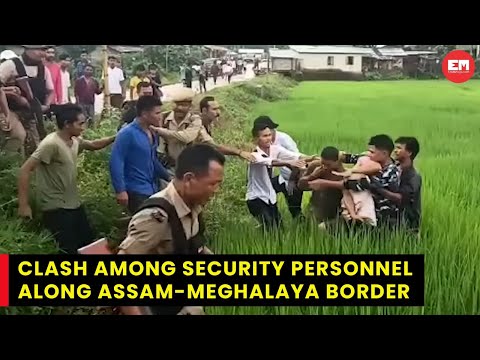
The situation worsened after May 14, 2010, when clashes broke out between the Nepali, Khasi and Garo communities. Assam police fired on the people, resulting in the death of four Khasis. At least 18 others were injured in the incident.

In 2012, hundreds of Khasis sat on a hunger strike. Officials and police forces were deployed to defuse the situation. The agitators formed a human chain to prevent government officials from Assam entering the area.
“Disputes between people of both the states have been going on for a long time. It is a good sign that both governments are trying to resolve it. We suggest the government go for a referendum on the dispute. What the majority of the people say should be implemented,” said Heading Sanglein, a senior citizen of Langpih.
“The Khasis want to stay in Meghalaya. We will not be comfortable in Assam,” he said.
“The referendum will be the best way to put an end to the dispute,” he added.
“Many organisations, including the Khasi Students’ Union (KSU) and the Federation of Khasi Jaintia and Garo People (FKJGP), have already placed their demands for a referendum on the issue. We support it,” said Hep Domenic Jahlang, KSU leader, Langpih.
Also read | NE Olympic Games: Assam to face Nagaland in basketball semifinal

You just read a story that took days to report. Help us keep our reporters on the ground in the Northeast.
Ad-free reading, support and keep important stories alive
Support once (any amount)

Scan to pay via UPI